Bitcoin Volatility Collapses, Yet Downside Hedges Stay Costly
Implied volatility in Bitcoin options has dropped sharply, but traders are still paying a premium to protect against further losses.
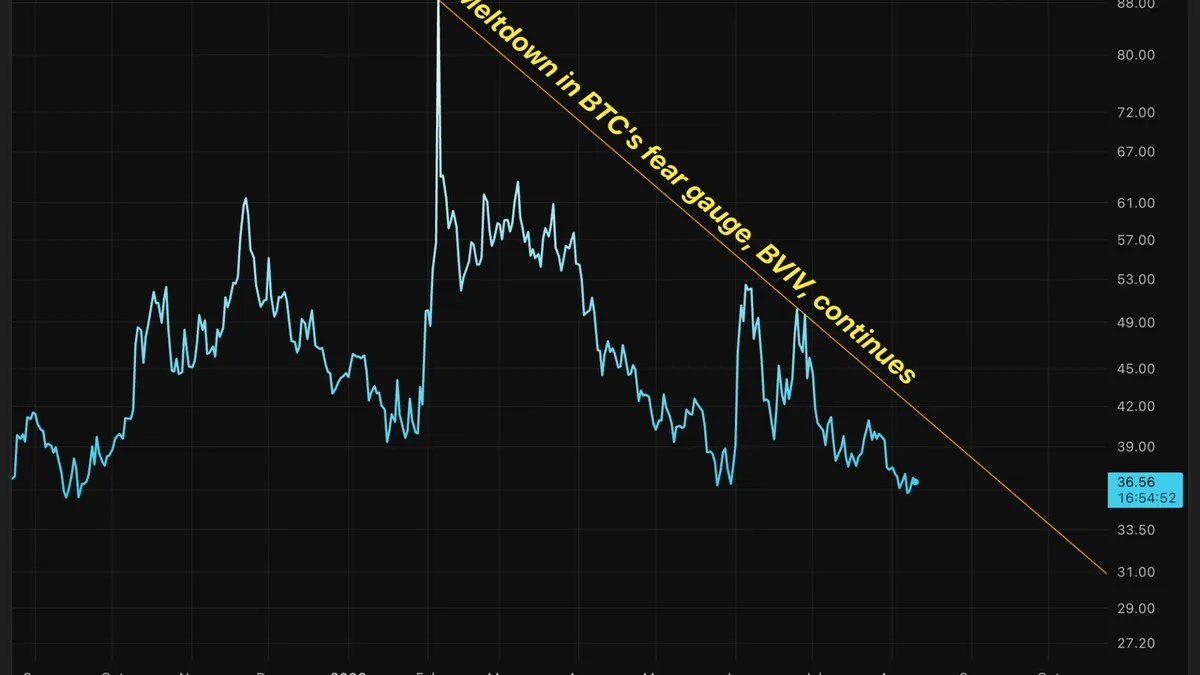
Bitcoin's options market is sending a nuanced signal: while overall volatility expectations have declined markedly, the cost of insuring against a price drop remains elevated relative to equivalent upside bets. That asymmetry — calm on the surface, anxiety underneath — reflects the cautious posture traders are adopting even as spot prices stabilize.
In derivatives markets, implied volatility serves as a real-time gauge of how much turbulence participants expect. When it falls, it typically suggests traders are less fearful of dramatic price swings in either direction. Yet the persistent premium on put options — contracts that pay off if Bitcoin's price falls — tells a more complicated story. Demand for downside protection is holding firm even as the headline fear gauge retreats.
Read more US Stocks Diverge as Oil and Yields Surge on Iran Tensions →
This kind of skew, where puts command higher premiums than equivalent calls, is a well-understood phenomenon in traditional equity markets, often linked to institutional hedging and the asymmetric psychology of loss aversion. Its presence in Bitcoin options suggests that the crypto market is maturing in its risk-management behavior, with participants increasingly treating hedging as a baseline discipline rather than a panic response.
The broader implication is that market participants may not fully trust the current calm. Falling volatility can reflect genuine consolidation, but it can also precede sharp directional moves. When sophisticated traders continue paying up for puts despite cheaper overall options pricing, it suggests a consensus view that the risks ahead remain skewed to the downside — even if nobody is predicting an imminent crash.
For retail investors, this dynamic is a reminder that professional crypto traders now operate with a risk framework that looks increasingly similar to traditional finance. The derivatives market is pricing in caution that the spot market's relative quiet might otherwise obscure. Continue reading at CoinDesk.