Iran-US Military Escalation Spreads to Gulf as Oil Stays Calm
US strikes on Iranian infrastructure and Iranian missile attacks on Bahrain mark a dangerous new phase, yet oil markets remain surprisingly subdued.
A significant escalation between the United States and Iran unfolded during Asia-Pacific trading hours, with American cruise missiles destroying two railway bridges in Iran's Golestan province — the first US strike on Iranian infrastructure since a ceasefire lapsed. CENTCOM confirmed strikes against roughly 90 Iranian coastal military targets, encompassing air defense systems, missile and drone storage facilities, naval assets, and logistics nodes. The breadth of the target list signals a deliberate effort to degrade Iran's retaliatory capacity rather than simply respond in kind.
Iran did not absorb the strikes passively. The Islamic Revolutionary Guard Corps pledged a response to the bridge attack, and Iranian missiles landed on Bahrain, triggering air raid sirens across Gulf states. Iran's parliament speaker warned that the Strait of Hormuz — the chokepoint through which roughly a fifth of global oil passes — would remain closed, a threat that carries enormous economic weight if sustained. The escalation represents a qualitative shift: attacks are no longer confined to military facilities but now include civilian and economic infrastructure on both sides.
Read more Binance Expands Into Gold and Silver Options Trading →
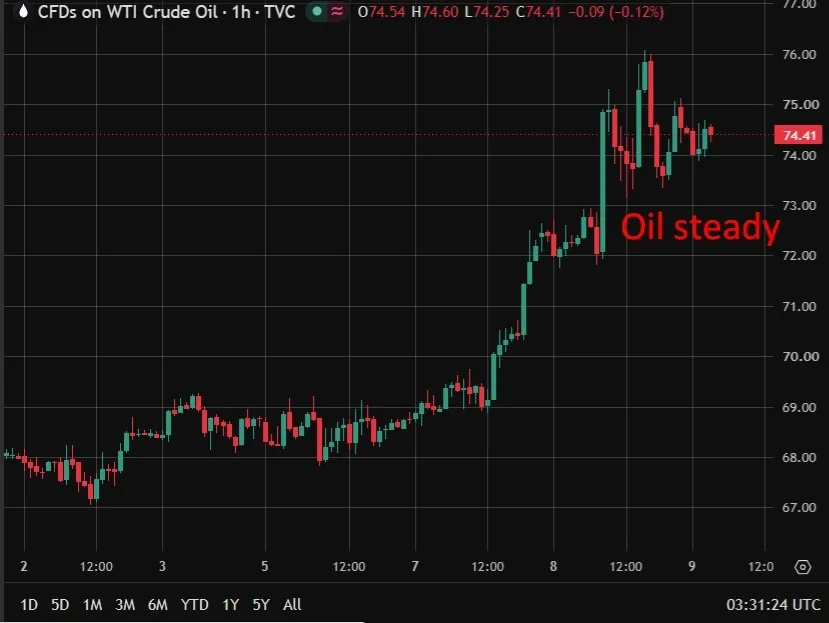
Perhaps the most striking market signal was what did not happen: oil prices barely moved. Crude edged only modestly higher despite the Hormuz threat, suggesting traders either doubt an extended closure is operationally feasible or are pricing in Trump's claim that Iran reached out to negotiate a deal, telling reporters the Iranians "called a short while ago" and want to make a deal. That diplomatic thread, if real, could explain the market's relative composure even as the battlefield noise intensifies.
Elsewhere in the Asia-Pacific session, equity markets showed resilience underpinned by a chipmaker rally that lifted Japan's Nikkei and South Korea's Kospi. South Korea's central bank flagged a potential rate hike as inflation runs at multi-year highs, while China's factory-gate prices hit a four-year peak even as consumer inflation undershot expectations at 1.0% year-on-year against a 1.2% forecast. The divergence between surging producer prices and cooling consumer demand in China adds another layer of complexity to a region already navigating geopolitical risk.
Continue reading at Forexlive